Lineage & History
Saisho Ein Sanmaya Horyu (最勝恵印三昧耶法流), the “Supreme Wisdom-Seal Samaya Dharma Lineage,” or Ein Horyu for short, refers to a stream of Shingon Shugendo teachings historically transmitted at Sanboin, a subtemple of Daigoji in Kyoto.
Daigoji was founded in 874 by the monk Shobo (832–909), posthumously known as Rigen Daishi. Ein Horyu is said to have begun when Rigen Daishi, who greatly revered Jinpen Daibosatsu, the founder of Shugendo, awakened to the truth of teachings unifying mikkyo (esoteric Buddhist practice) with mountain prayers and rituals. Tradition records that he transmitted the Ein Horyu practices, which over time became a core ritual lineage within Daigoji-Sanboin Tozan-ha Shugendo.
Ein Horyu has its own esoteric transmissions, including denju and kanjo, teaching and empowerment, practiced within the lineage. It is a complete Shugendo system encompassing deity yoga, goma, saito goma, mountain training, and many other practices for diverse purposes.
During the Meiji period, in the late nineteenth century, state policies suppressing Shugendo deeply disrupted many mountain ascetic communities, including those connected with Daigoji. The teachings were nevertheless preserved, and in the early twentieth century Ein initiations and ritual transmissions were revived and re-established within Daigoji-Sanboin. Today, Ein Horyu continues to transmit this heritage founded by Rigen Daishi.
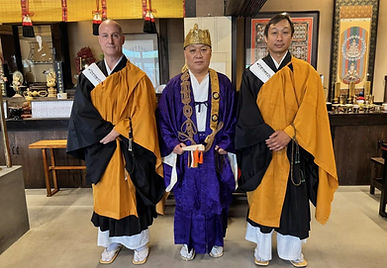
In 2025, after years of practicing various streams of Shugendo and receiving Shingon and Tozan-ha Shugendo ritual transmissions including saito goma, two ISA directors received the Ein Horyu teachings, denbo kanjo, and finally dento - lineage transmission - from Tenshu Dai-Ajari in Saitama, Japan. At the time, he stated that this unusual transmission was being given because he perceived a danger that Ein Horyu might die out in Japan.
Thus charged to transmit legitimate Shugendo practice more widely and establish gyoba, Shugendo training areas, outside Japan, the International Shugendo Association was born. The religious name used for our organization is Kosei 光成, “Bright Attainment,” Shugendo.